.jpg)
50-Ohm Load/Cold Sky Y-Factor as an EME Receiver Diagnostic
A simple and repeatable measurement for characterizing an EME receive system is the Y-factor: comparing receiver output power between two noise references of known, differing temperature. The most practical version of this test for most EME stations switches the LNA input between the antenna feed (pointed at cold sky) and a 50-ohm termination at a known or easily measured ambient temperature (e.g. 293K = 20°C = 66°F). Since most dishes cannot be physically pointed down at the ground - elevation limits, mount geometry, and risk of ground strike usually rule it out - the 50-ohm load is, in practice, the reference most EME operators actually use.
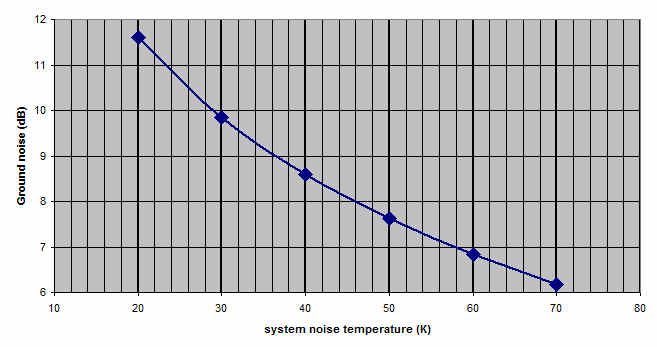
Here's a typical ploy of measured 50-ohm Y-factor vs System noise temperature for 23cm. A reasonable value for the Y-factor is around 8dB at 25°C for a system which includes an isolation relay,
Why the 50-Ohm Load Is the Practical Reference
A 50-ohm load has real advantages as a hot reference. Its physical temperature can be measured directly and accurately (a thermometer on the load, rather than an estimate of ground brightness temperature). It presents a true matched impedance, so there is no ambiguity about reflection or coupling loss the way there can be with a feed looking at terrain. And it is trivially repeatable - the same load, in the same place, gives the same answer every time, unaffected by weather, ground moisture, foliage, or dish elevation. A relay or coax switch ahead of the LNA makes swapping between antenna and load quick and repeatable, and the test can be run at any time without needing the dish to be pointed anywhere in particular.
The tradeoff is what the measurement actually characterizes. The 50-ohm load Y-factor is taken at the switch point ahead of the feed - typically right at or near the LNA input. It characterizes everything from that switch point onward: the LNA and any cable/connectors between the switch and the LNA. It says nothing about the feed itself, spillover, dish surface accuracy, or the cable/connectors between the feed and the switch, because none of that hardware is in the signal path when the load is selected.
Why the Load Method Is Especially Good for Measuring Small Passive Losses
Beyond convenience, the 50-ohm load reference is arguably the better choice specifically when trying to detect small changes in passive loss ahead of the LNA - for example, comparing a direct LNA connection against a chain with an added relay and longer cable run. The reason comes down to measurement sensitivity.
The Y-factor is a ratio of hot to cold total noise power: Y = (T_hot + Tsys) / (T_cold + Tsys). With the hot reference around 290-300K and the cold reference (sky) only around 20-40K, the cold side of the ratio is comparable in size to Tsys itself (a few tens of Kelvin), while the hot side is dominated by the ~300K reference and barely moved by Tsys at all. This means a small change in Tsys - even a fraction of a Kelvin, from a hundredth of a dB of added cable loss - represents a sizeable fractional change in the cold-side total, and shows up as a proportionally amplified swing in Y. In other words, small passive losses that would be essentially invisible on a network analyzer become readily visible as a measurable shift in Y-factor (or in dB terms, a shift of a few tenths of a dB in the reading), simply because the cold reference is "close" in magnitude to the very quantity being measured.
This amplification effect exists for both ground-referenced and load-referenced Y-factor, since both use a similar ~290-300K hot temperature. What makes the 50-ohm load preferable for this purpose is that its hot reference is precisely known and rock-stable from one measurement to the next. With a ground reference, some of any observed Y shift could be measurement-to-measurement variation in ground brightness temperature, moisture, or feed coupling - real effects, but ones that muddy the comparison when the goal is isolating a specific hardware change. With the 50-ohm load, the hot reference is essentially fixed, so a change in measured Y-factor between two configurations can be attributed with much more confidence to an actual change in the receive chain rather than reference drift - making the load method the more sensitive and trustworthy tool for tracking down small incremental losses.
Isolating LNA and Cable Contributions
Because the load bypasses the feed, the Tsys derived from a load-to- cold-sky measurement represents only the LNA and whatever passive components sit between the switch and the LNA - not the feed, spillover, or antenna-side cabling. Comparing this Tsys against the LNA's own known noise figure (from a datasheet or independent calibration) lets the loss of the intervening hardware be backed out via the standard cascade relation. Comparing Tsys across two configurations - as when isolating the effect of adding a relay and extra cable - reveals the incremental loss of just that added hardware, largely independent of feed or antenna effects, and often resolvable down to hundredths of a dB thanks to the sensitivity described above.
What Load-Referenced Y-Factor Cannot Tell You
Because the antenna and feed are switched out of the path entirely during the hot-load measurement, this test is blind to the feed. It cannot detect feed mismatch, spillover, or illumination efficiency issues, since none of that hardware is exercised when the load is selected. There is one indirect exception: the cold-sky reading in the load test still passes through the feed, so - if Tsys from the load side of the chain is already known independently - the antenna temperature implied by that cold-sky reading can, in principle, be backed out and compared against the expected value (e.g. ~25K). If the implied Tant is higher than expected, that points toward a problem in the feed or antenna-side cabling. But this only works as a feed check when the LNA's noise contribution is pinned down from elsewhere; the raw Y-factor number by itself only gives the combined Tant + Tsys, not either quantity separately.
Summary: What These Measurements Can and Cannot Tell You
- Both load-referenced and ground-referenced Y-factor give an estimate of system noise temperature (Tsys), useful as a comparative tool for tracking hardware changes over time, even when the absolute change is a few hundredths of a dB.
- The load-referenced version is generally the more practical and more repeatable of the two, and is well suited to isolating small incremental losses in cable, connectors, and switching hardware ahead of the LNA.
- Neither measurement, on its own, can separate feed spillover loss from cable/connector loss from LNA noise figure - additional independent information (a known LNA noise figure, or a true ground-referenced measurement where geometry allows) is needed to fully decompose the budget.
- Neither measurement directly checks impedance match; a feed with poor VSWR can still produce a plausible-looking result if the mismatch loss is small, masking a return-loss problem a VNA sweep would catch immediately.
- Absolute Tsys values carry meaningful uncertainty, since both the cold-sky temperature and (for the ground-referenced case) the ground brightness temperature are estimates rather than calibrated references - but relative comparisons between configurations remain reliable.
- Neither test says anything about receiver linearity, intermodulation, or dynamic range - a low-noise but easily overloaded front end will look fine in this test and only reveal problems under strong signal conditions.
Addendum: Ground-Referenced vs 50-Ohm Load-Referenced Y-Factor
The two measurements differ mainly in what part of the chain the hot reference exercises. A ground-pointing measurement passes the hot reference (the ground) through the full front end - feed, spillover, match, and all cabling ahead of the LNA - so it characterizes the entire system, but at the cost of an estimated (not directly measured) ground brightness temperature, and possible near-field or mismatch effects between the feed and the ground that are hard to quantify. There will almost certainly be a mismatch between the LNA and the feed when mounted on the dish which can give rise to changes in gain and/or noise figure which can complicate measurements. A 50-ohm load measurement switches the hot reference in near the LNA, bypassing the feed entirely, giving a precisely known and highly repeatable reference temperature, but it only characterizing the LNA and any hardware between the switch and the LNA - it is blind to the feed itself. In practice, the load measurement is the more accessible and more sensitive tool for day-to-day tracking of receive chain health and for isolating small component losses, while a true ground measurement (where the dish geometry allows it) remains the only direct way to capture the feed's own contribution to system noise.
Appendix I: Worked Example
As an example, consider two 50-ohm-load-to-cold-sky Y-factor measurements. The first, 8.5dB, is with the antenna connected directly to the LNA via a single SMA pair and a short 4cm length of RG-402. The second, 8.2dB, is the same chain with an SMA relay added ahead of the LNA - contributing two additional SMA pairs and a further 2cm of RG-402. Assume an LNA noise figure of 0.25dB, a hot load at 300K, and an antenna-side noise contribution broken into three parts: 5K cold sky brightness, 15K spillover, and 1K feedthrough loss - giving a total effective antenna temperature Tant = 5 + 15 + 1 = 21K.
Before computing Tsys, it is worth checking the ceiling: the best possible Y-factor (zero loss ahead of the LNA, so Tsys = Te = 17.8K) is Y_max = (300 + 17.8) / (21 + 17.8) = 8.9, or 9.14dB. Both measured values (8.5dB and 8.2dB) are comfortably below this ceiling, so the inputs are physically consistent this time.
Converting to linear Y-factors: Y1 = 7.08, Y2 = 6.61. Using Tsys = (Thot - Y . Tant) / (Y - 1):
- Direct (SMA pair + 4cm RG-402): Tsys1 = (300 - 7.08 x 21) / 6.08 = 24.9K
- With relay (2 more SMA pairs + 2cm RG-402): Tsys2 = (300 - 6.61 x 21) / 5.61 = 28.8K
The LNA's own Te, from its 0.25dB noise figure, is 17.8K. Both Tsys values sit comfortably above this, as they should - solving the cascade relation Tsys = Tphys(L-1) + L.Te for the loss L ahead of the LNA gives:
- Direct connection loss: 0.096dB
- With relay, loss: 0.148dB
The difference between the two - 0.051dB - is attributable to the 2 added SMA pairs and 2cm of RG-402 introduced by the relay. This matches the incremental loss found in earlier variants of this same calculation (using different Y-factor and Tant assumptions), even though the absolute loss figures themselves shift noticeably with the assumed antenna temperature (0.096dB and 0.148dB here, versus different absolute values under other Tant assumptions). This reinforces the general point: absolute Tsys and loss values from a single measurement are only as good as the assumed reference temperatures, but comparative (differential) results between two configurations are far more robust to those same assumptions.