.jpg)
Extending the Cooker Dish - proof of concept
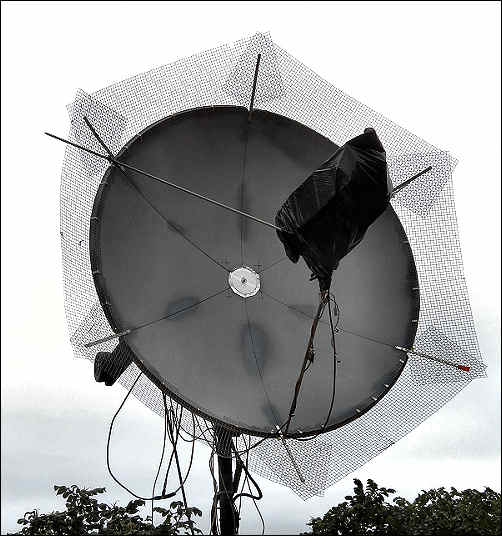
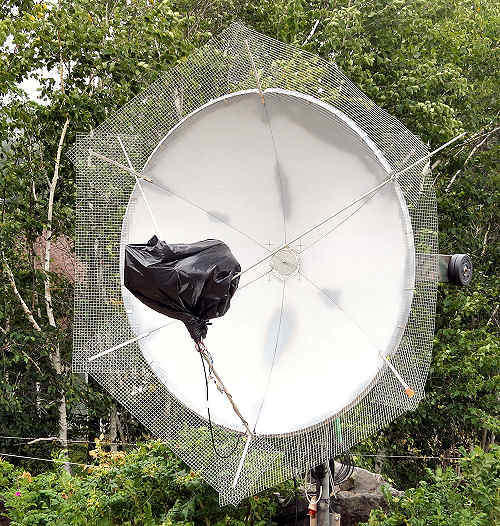
Extended "cooker" dish. The feed is in a plastic garbage bag for weather protection!
Since I first showed that an inexpensive 1.5m "solar cooker" could be turned into a pretty effective antenna at 23cm (and it even works well at 3cm)https://bobatkins.com/radio/150cm_EME_dish.html, quite a few stations have started using this dish for EME. It works very well for a small 1.5m dish and work has been done to optimize its performance by a number of stations using theoretical modeling of feeds, notably by KB2SA.
I don't do modeling. Typically I'll get an idea based experience and see if it works. That was the origin of the cooker dish. The construction looked a lot like that of Chinese TV satellite dishes, so I put one on 23cm (and 3cm) and found that indeed it worked and worked rather well.
So what's the most obvious thing you could do to make it better. In my mind the obvious answer was to make it bigger. That's what I did with my original 2.8m dish, turning it into a 3.1m dish with excellent performance, so why not the cooker dish?
Expanding a dish can do two things. First it can increase gain (giving better Tx and Rx) and second it can reduce spillover, which gives you a better G/T and hence better Rx performance. However a number of things have to be considered when expanding a dish. How accurately does the expended section have to match the parabolic profile of the existing dish, and what does it do the the F/d ratio since the "F" is fixed, it's the focal length of the parabola (whatever its diameter).
The cooker dish appears to have a focal length around 22" (56cm), which puts its native f/d at something like 0.37. If it was expended to a diameter of 1.7m, the f/d would drop to about 0.33 and if it was expended to 1.8m, the f/d would further drop to 0.31. It gets hard to efficiently feed a dish with such a low f/d ratio, though that doesn't mean it wouldn't still perform better, especially on receive, since spillover would still be reduced even if gain increase wasn't as much as it could be. In general a feed is a compromise between maximum gain and maximum G/T. You do not generally get best gain and best G/T with the same f/d and a given feed. I'd say there would be no real point in making f/d less than about 0.3 as you are getting into an area of diminishing returns at that point.
How accurately the extension needs to match the parabolic profile of the original dish depend on the frequency in use. Attempting to get better 10Ghz performance would probably be a futile effort, but at 23cm it's not. If the surface of the extension matched the original parabolic profile to within +/- 1/20th of the wavelength, it will be fine. At 23cm that's about a +/- 1/2" tolerance. For that you really don't have to put any exotic bends in the extension. A flat extension of 20cm which follows the same slope as the dish surface at the rim would probably work just fine. You can bend it up a bit (by maybe 5 degrees) at the 10cm point, but you probably won't see a lot of difference.
What I'm describing isn't an elegant piece of engineering and metalwork (though it could be if you wanted to make it that). It's a quick, cheap hack using parts you can get at a local hardware store and do the work in a less than a day for about $30. It's easy to do and quite hard to get wrong.
Building it
So what did I do. Well, the first thing was to attach six short "ribs" extending out from the dish surface which follow the slope of the surface at the edge. You can do this close to the edges of the 6 "petals" that make up the dish. I used 1/2" x 1/8" aluminum strip. A attached them to the dish surface using 3 or 4 2-56 screws, I actual drilled and tapped 2-56 holes in the dish surface. It's very thin, but it can be tapped for 2-56 screws and they will hold quite well. You could use screws and nuts, but I didn't. Each rib as 12" long and about 10" of this extended past the rim of the dish.
So now there are 6 "ribs" sticking out from the dish. To make a surface I used 1/2" mesh "hardware cloth", which is just 1/2" square chicken wire designed for making fences. It's not a precision product. It comes in rolls and it's hard to get flat. Even after you bend it as flat as you can get it, it still often has a "warp" in it. Maybe there's a well made product that is perfect, but the hardware store cheap (possibly Chinese made) product isn't. So you do the best you can with what you have. It may lay better on the dish one way up then the other, depending on just how it is bent or warped. I cut six approximately 12" x 42" rectangular pieces out of a roll and flattened then as best I could. Caution - this stuff can be sharp. Beware if scratches and cuts. Gloves can be useful when working with and cutting it. It cuts fine with tin-snips or heavy duty wire cutters.
This isn't going to be a nice, round extension making a 1.5m circular dish into a nice round 1.7 or 1.8m dish. It's going to end up hexagonal. Purists would then say it's hard to feed properly because the f/d across the flats is different from the f/d measured between vertices. They would be right. Does it matter? Probably not a lot. Would it be better of it was a perfect circle with a nice rim? Probably. Would it be worth the effort? in my opinion, probably not.
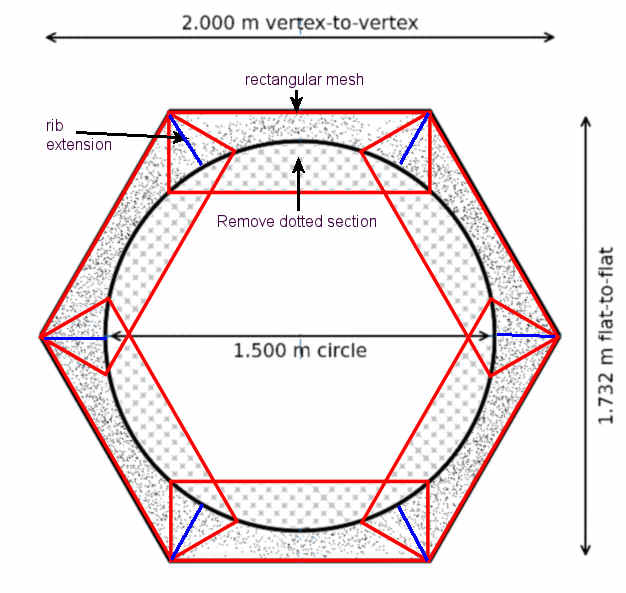
So you lay the rectangular sheets between the ribs. The inner ends of the sheet lay on the rim of the dish. You attach it to the ribs using whatever comes to hand. Cable ties work OK. Then you figure it some way to tie the sheet down to the rim on the dish. You could drill holes and use cable ties or twisted wire. You could bend up some clips which would do the same things. Whatever works for you. The trim off as much of the overlap with the dish as is practical using a pair of wire cutters.
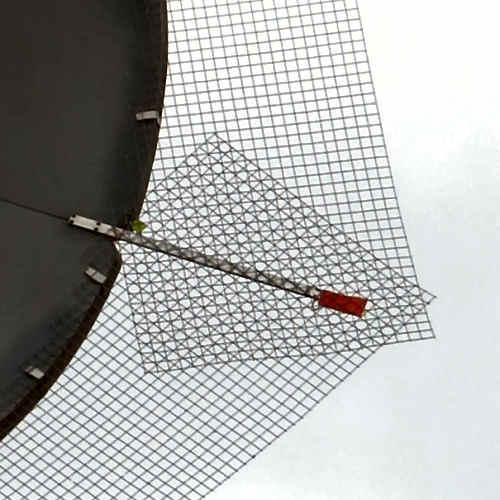
Detail of "rib" and overlapping mesh sheets
Then you "eyeball" the overall shape of the mesh sheet and attempt to bend or otherwise stretch and distort it into something that looks like it might be following the dish profile. This sounds easier than it is because this mesh doesn't cooperate when you try to bend it in two dimensions. It might need some cutting of wires in the mesh, but in the end you can do it. It might look ugly, but ugly (within reason) can work. Even if the extension isn't a great match to dish parabolic profile, it will still reduce spillowr (leading to better Rx performance) even if it does not give as much additional gain as it would if a perfect parabolic match.
That's it. Keep the same feed you have and it will probably work (mine did). If you want to modify feed design, you can. I have no idea how much better you could make it, or how much effort that would take. I'm sure someone will come up with some sort of feed modification (probably a different flare for a Septum style feed)
What if the extension is not parabolic?
First, the extension doesn't need to be perfectly parabolic to increase potential gain. At 23cm, if it's within about +/- 1/2" of the ideal profile, there won't be a huge difference. Second, as mentioned above, even it's so bad that it doesn't contribute any gain at all (which is pretty unlikely), it will still cut down spillover noise contributions.
So just how much better is it?
I can't absolutely quantify that. It's better, of that I'm pretty sure. With my feed and my dish and my crude extension, I'd say it might be 1.5dB better on receive. With the sun at around 110SFU I can see something like 10.5dB of sun noise. On actual EME signals it seems to outperform a 1.5m dish by a dB or two at least and more than that on some poorly performing dishes.I'm still testing it and tying to get a better handle on its performance Is it worth doing? I'd say yes, for me it was. Cost it around $30 in parts. You can get the hardware from stores like Lowes, Tractor Supply, Home Depot etc.(except for 2-56 screws and nuts). It takes a day to do it. If you don't like it you can always remove it. In principle it should not affect 3cm performance because 1/2" mesh is almost "not there" as far as 3cm is concerned. It won't improve the dish performance, but it won't make it worse either. I don't know if the extension will hold up to snow, ice and wind, that will depend on how well you build it.
If you compare a 1.75m f/d 0.32 dish with a 1.5m f/d 0.38 dish, using a standard septum, you might expect to see about a 1.25dB increase in gain (effective Tx power) and maybe up to a 2dB improvement in Rx due to lower spillover. That could make echoes maybe 3dB stronger. I'm not saying you will see such a change, but it's not outside the realm of possibility. It depend on your feed pattern to some extent.
The best performance to date is sun noise of around 10.5db when the SFU was around 110 (at 10.7cm). This would correspond to sun noise of about 11.8dB at an SFU of 150. Based on measurements from last year using the same feed, I saw around 10.1dB at an SFU of around 155. So it looks like an improvement of around 1.7dB. All sun noise numbers have some degree of uncertainty, but I'm pretty careful about these measurements using step attenuators to minimize any non linearity in the measurement system. I believe, for me, this improvement is real. Your mileage may vary of course. You may get more, you may get less, you may even get none. No guarantee of performance should be inferred from my numbers. For example my original 1.5m dish feed may not have been optimized for the dish. A better optimized feed might have given better results.
The feed I'm using is the copper foil coated wooden lightweight septum described here - https://bobatkins.com/radio/lightweight_septum_feed.html It's almost the exact same feed I use with my 3.1m dish (f/d around 0.34). Basically a standard OK1DFC stepped septum with a short flare. No choke. The black plastic bag over it keeps the rain off, though a white one might keep it cooler. 23cm losses should be negligable.
As I said at the start of this article, this is a "proof of concept" project. I don't depend on this dish for my day to day EME activity, so I can afford to experiment with it. I asked myself the question whether it would be worth the effort to extend the dish a bit, even if I made no other changes. The answer is apparently yes. What this won't do is turn a poor existing 1.5m cooker dish into a good performer. If it's not working right as it stands (for whatever reason), then an extension like this won't cure your problems. For that you might need to look at issues of losses around the LNA, bad feed construction, improper configuration, lossy cables and connectors etc.