

Canon Speedlites - 580 EX II, 430EX, 430EX II, 220EX, MR-14EX, MT-24EX (plus 380EX, 420EX, 580EX and 550EX)
The Canon speedlite system is a source of confusion to many new (and quite a few old!) Canon EOS users. This has been made somewhat worse with the introduction of DSLRs as they are not really compatible with early "EZ" series Speedlites. DSLRs require newer "EX" Series speedlites in order to provide a reasonable degree of automation and allow automatic exposure.

"EX" series speedlites allow the use of E-TTL (and E-TTL II) which are flash metering systems which use a preflash and the camera's multi-zone evaluative metering system to determine optimum flash exposure. Earlier "EZ" series speedlites did not use a pre-flash and determined flash exposure by measuring the amount of light being reflected from the film surface onto special flash exposure sensors during exposure. [Note that "EX" series speedlites default to the older "A-TTL" mode of the "EZ" series when used with older EOS bodies which don't support E-TTL.] Since DSLRs have no film and they are anti-reflection coated, this metering system can't be used and so "EZ" series speedlites are incompatible with auto exposure on Canon EOS DSLRs. They can be used in a fully manual mode, i.e. basing the aperture setting on the camera on the guide number of the speedlite, the ISO setting and the subject distance.
ETTL-II is very similar to E-TTL, except it uses a slightly different algorithm to calculate flash exposure and it can also factor in the distance to the subject when required. You can read a bit more about it here - ETTL II
"EX" series speedlites do provide the pre-flash which E-TTL (and E-TTL II) metering requires. TAs of August 2008, there are currently three "EX" series speedlites in production (plus a couple of specialized macro ringlites). They are the 580EX II, the 430EX II and the 220EX (with the 420EX and 550EX discontinued and the 430EX soon to be phased out). They differ both in flash power and in features. They all support FP high speed flash sync (at reduced power). There are also two specialized macro speedlites, the MR-14EX and the MT-24EX.
Canon Speedlite 220EX
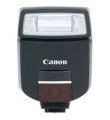 The 220EX is the least expensive and has least features. It's a simple speedlite with head that neither tilts, swivels nor zooms. It has no manual power adjustment. The main advantages of using an external speedlite like the 220EX is that it gives you more power then the built in flash on the 10D/20D/300D/350D, it gets the flash head slightly higher (so may result in slightly less "red-eye") and it saves you from drawing flash power from the DSLR battery.
Canon Speedlite 380EX (discontinued)
This was the predecessor of the 420EX (see below). It has a zoom head which can be tilted for bounce flash, but which does not swivel like that on the 420EX. It does not have the capability to be used as a wireless slave. It's a good basic flash. Much better then the 220EX.Canon Speedlite 420EX (discontinued)
For only a little more money, the 420EX offered significantly more capability than the 380EX. It has a head that tilts, swivels and zooms for example. The tilt and swivel head allow for bounced flash (which often gives a more pleasing result than direct flash), and the zooming head optimizes the flash coverage to the lens field of view from 24mm to 105mm. The 420EX can also be used as a slave in wireless flash operation.Canon Speedlite 430EX
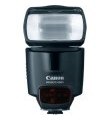 The replacement for the 420EX, the 430EX adds manual zoom and power control, custom functions, automatic zooming
correction based on image sensor size for current DSLRs, transfer of white balance info to current DSLRs capable of reading it, and LCD readout and faster recycling times. The 580EX and 530EX II (see below) add the ability to act as a wireless master, increased power, external power options, more custom functions and stroboscopic operation.
The replacement for the 420EX, the 430EX adds manual zoom and power control, custom functions, automatic zooming
correction based on image sensor size for current DSLRs, transfer of white balance info to current DSLRs capable of reading it, and LCD readout and faster recycling times. The 580EX and 530EX II (see below) add the ability to act as a wireless master, increased power, external power options, more custom functions and stroboscopic operation.Canon Speedlite 430EX II
This update of the 430EX was announced in June 2008. The 430EX II features the same basic appearance and layout as the 430EX, but adds a metal shoe with the same locking mechanism as the Speedlite 580EX II and 1/3 EV step output control in manual mode. The 430EX II can also be fully configured via the rear LCD menus of recent Canon digital SLRs as well as from it's own LCD control panel. The recycling time of the 430EX II is 20% faster than the 430EX and recycling is much quieter. Like the 430EX, the 403EX II can act as a wireless slave, but not as a wireless controller. As of August 2008 the 430EX II had not yet started shipping, but the initial estimated street price is expected to be around $330. The current (August 2008) price of the 430EX is around $240.Canon Speedlite 550EX (discontinued)
This was Canon's "top of the line" speedlite before the 580EX (see below) was introduced. It has most of the features of the 580EX, except for the color temperature and "digital awareness" of the 580EX. It's no longer listed as a current product by Canon though. It's very nearly as full featured as the 580EX and it can be a good buy if you can still find one at a discount price. It's actually the speedlite that I still use.Canon Speedlite 580EX (discontinued)
This was the "top of the line" speedlite before the 580EX II. Like the 430EX it has a head that tilts, swivels and zooms. However it's loaded with extra functions. It can act as a wireless controller for wireless flash operation (and it can also act as a slave). It has a variable stroboscopic flash mode (from 1 to 199 flashes/sec at from 1/4 to 1/128 power) and in manual mode the power can be set anywhere from full power to 1/128 power. The zoom head can be manually set. It's smart enough to know the sensor size on DSLRs made after the EOS 300D and adjust the flash zoom setting to allow for smaller sensors (which results in less wasted light). It can tell the DSLR about variations in the color temperature of the light due to charge level and so allow for automatic color balance corrections. There are also 14 user setable custom functions. About the only thing it doesn't do is make coffee.Canon Speedlite 580EX II
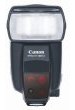 Based on Canon's earlier 580EX Speedlite, the 580EX II adds weathersealing, a stronger metal mounting foot and has a 20% faster recycling time. The main functional differences are that the 580EX II also has an external metering sensor for non-TTL automatic flash exposure control and a PC socket for use with non-dedicated slave triggers.
Canon Speedlite MR-14EX
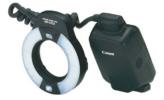 The MR-14EX is designed for close-up and macro shooting. The circular twin flash tubes can fire at the same power, or power can be varied between them over a six-stop range. One or more 550EX(II) or 430EX(II) Speedlites can be used as wireless slaves along with the MR-14EX. The controller unit has an illuminated full-info LCD panel and its accepts optional hi-capacity battery pack. The price is around $475
Canon Speedlite MT-24EX
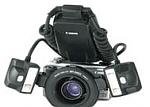 The Macro Twin Lite gives serious close-up, nature, and macro enthusiasts a different option in macro lighting - a directional quality of light, as opposed to the rather "Flat" character of the traditional ring lite. Two separate flash heads can be swiveled around the lens and aimed separately or removed from their holder and mounted off-camera. Like the MR-14EX, the MT-24EX is fully E-TTL compatible with all EOS bodies, including digital SLRs, and even allows Wireless E-TTL flash control with one or more 550EX(II) and/or 430EX(II)"slave units". It also provides easy ratio control of each flash head’s output, over a six-stop range. The price is around $685
Here's a table which summarizes some of the differences between the 580EX II, the 430EX and the 220EX Speedlites:
Which Speedlite to Buy?
If I was a typical amateur photographer who was looking for a new speedlite to go with a new DSLR, I'd probably go for the 430EX, unless I was really serious about getting into multiple flash photography. It has most of the features that average photographer is likely to need for single flash work. If you want to use multiple flash units, then the master wireless control features of the 580EX II are required but you'll still need a 430EX (or another 580EX II) as your wireless slave. The new 430EX II adds a number of features to the 430EX, but also adds $90 to the price ($330). Since you can get a 580EX II for under $410, I think I'd be tempted to get the 580EX II over the 430EX II, at least until the price on the 430EX II drops a little. The 430EX at around $240 is probably still the best value if you don't need a master wireless controller.

